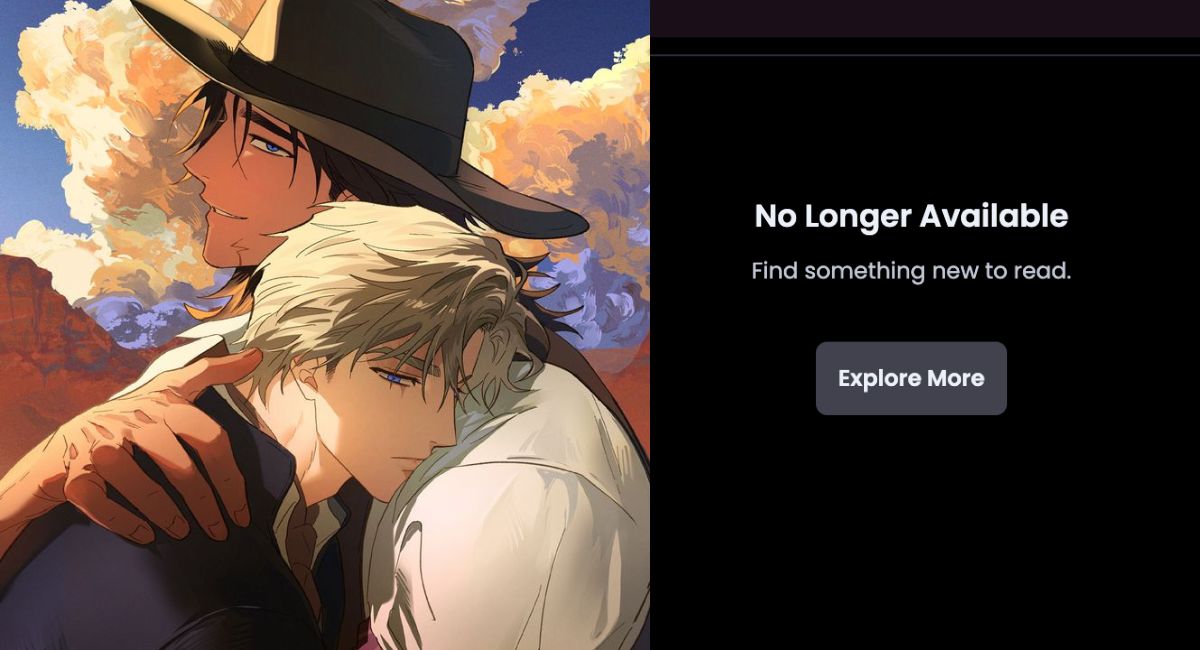
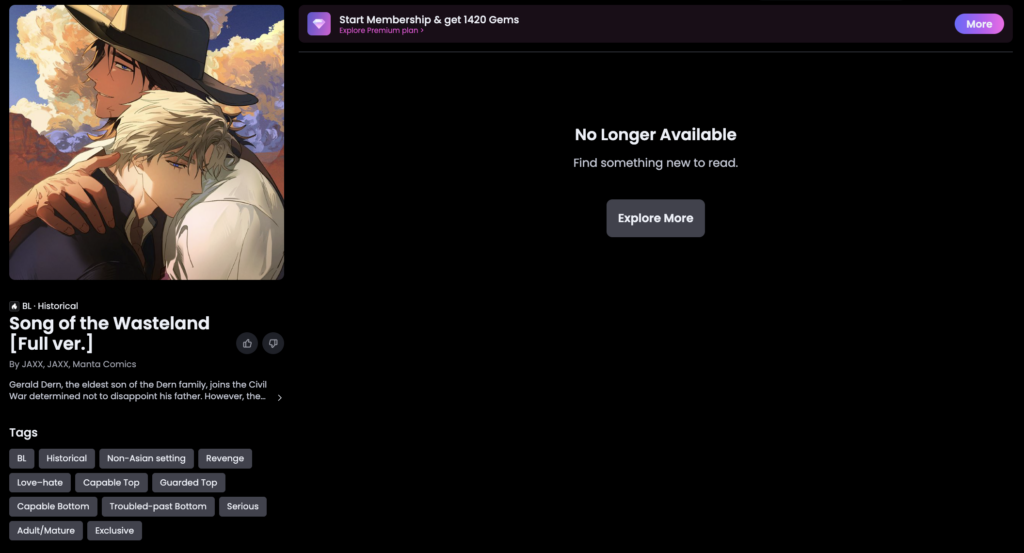
Song of the Wasteland has been discontinued as of June 25.
Last week, Manta/RIDI released the first chapter preview of JAXX’s newest BL manhwa Song of the Wasteland and a synopsis. Very quickly, readers noticed several extremely problematic and harmful elements in both the preview chapter and what’s promised to come in the summary.
Set in 1861, during the Civil War, the chapter opened with a white man named Gerald Dern whose family operated a ranch in Illinois and owned Black slaves. Gerald went off to fight in the war and returned to find his family dead and himself saddled with a mountain of debt. After dismissing the slaves and giving them some money, he meets the last remaining worker, a cowhand named Ezra who calls himself Gerald’s slave.
Romanticization of Harmful Stereotypes
TW: Discussions of slavery, rape, racism, anti-Black racism, and anti-Indigeneity
There were several issues in the first chapter already.
Song of the Wasteland isn’t set in a fictional time; it’s using a very real, very painful part of American history and to ignore it as such or to dismiss it, saying that this is “fiction” would be harmful to those who are still feeling the effects of that history today.
The lack of distinct facial features on the Black slaves shows a dehumanization to them. They had no names and the only lines that they spoke were of pure gratitude to Gerald for “freeing” them, and they still continued calling him “young master” to the end. This is further exacerbated by the white land agent, a minor character, being drawn with expressive features.
With Gerald Dern telling the slaves that they were “all free people who can’t be bought or sold with this ranch,” it’s a gross oversimplication of the abolition of slavery and only furthers the white savior trope where Black people can only be rescued by white people. Furthermore, the idea that the slaves can have a “better” life because they’re now free and have money is not historically accurate as they would have struggled to find employment and accommodations. It’s also hugely problematic the way Gerald frees the slaves, as it’s almost seen as a kindness or generosity on his part rather than the fact that it’s now illegal for him to own slaves and he’s legally obligated to free them. And it did not stop people from continuing to enslave Black people in any case.
Gerald is also spotlighted as someone with a “troubled past” (as seen in the manhwa tags), has lost everything, is depressed and suicidal. He’s meant to be sympathized. Readers are meant to feel sorry for him.
Except he’s a colonizer.
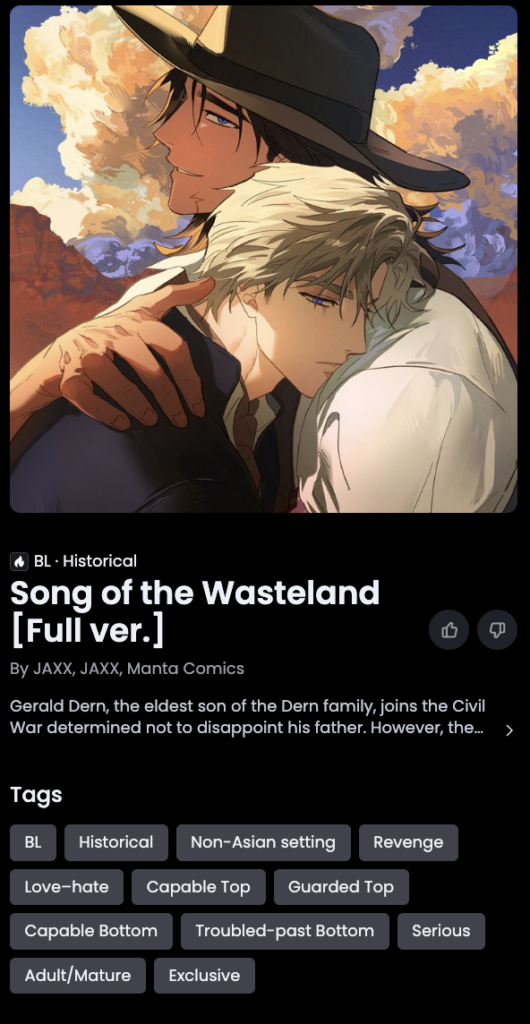
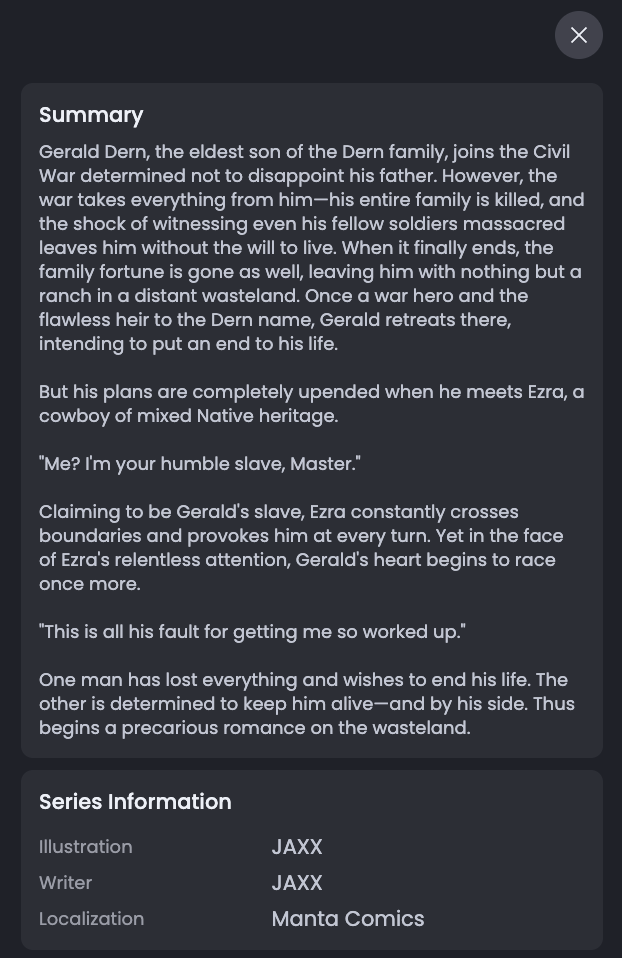
Then, there’s Ezra.
Described as a “cowboy of mixed Native heritage,” Ezra appears at the end and is shown with dark skin color and blue eyes with beads braiding one strand of his hair. So, now the story centers a romance between the colonized and the colonizer. Even if Ezra is depicted as the “top” and with that label, has the stereotype of being the “dominant” one (and thus making it seem like he has more power than Gerald), it doesn’t erase the historical context; it just makes it seem more palatable.
With Ezra being a child of “mixed Native heritage” and having blue eyes, it’s only yet another stark reminder of the violent history between white people and Indigenous peoples as the large majority of mixed children would have been products of rape. Plus, without the description of Ezra being half Indigenous, it’s hard to tell that he has any Indigenous roots which makes it seem like his Indigenous identity was created to add “exoticism,” which only perpetuates the otherness that Indigenous people faced back then and today.
This type of relationship–between a person of color with distinctly darker skin and a white person or someone with lighter skin–is a trope that is extremely common in comics (manhwa, manhua, manga, webtoons of all genres and not just BL). The character with lighter skin is often depicted as pure and innocent while the one with darker skin is depicted as being barbaric, violent, hypersexual, amongst other negative descriptors. While it’s not clear how JAXX intended to write Ezra and if they were planning to subvert those tropes, there is a clear blueprint for how POC with darker skin are portrayed in manhwa.
Granted, the tags about “revenge,” “troubled-past bottom,” “love-hate,” are not enough to tell the entire story but it’s enough to paint a probable picture that raises some red flags. Ezra is looking for revenge, which already treads into the stereotype of an angry, vengeful Indigenous person. There’s no telling what that revenge is, but if it has something to do with the ranch that Ezra claims is his, then it paints Ezra as a villain for reclaiming land that’s rightfully his.
The chapter also ends with Ezra saying, “I’m your humble slave, Master.” Perhaps it’s meant to be sarcastic, but having the colonized say that to the colonizer is
Considering that anti-Black racism and racism against Indigenous peoples are still running rampant today and the effects of the abominations against humanity that can be still felt today, using their trauma as a historical setting for a romance manhwa is distasteful and disrespectful to say the least.
Jaxx Apologizes; Manta Issues Statement
On June 25 at 1:32 AM PST, Jaxx issued an apology in English then Korean. They admitted that their storytelling lacked the necessary “care and nuance” that a story with such a heavy historical backdrop demanded and did not do the required research. Their full apology can be read below:
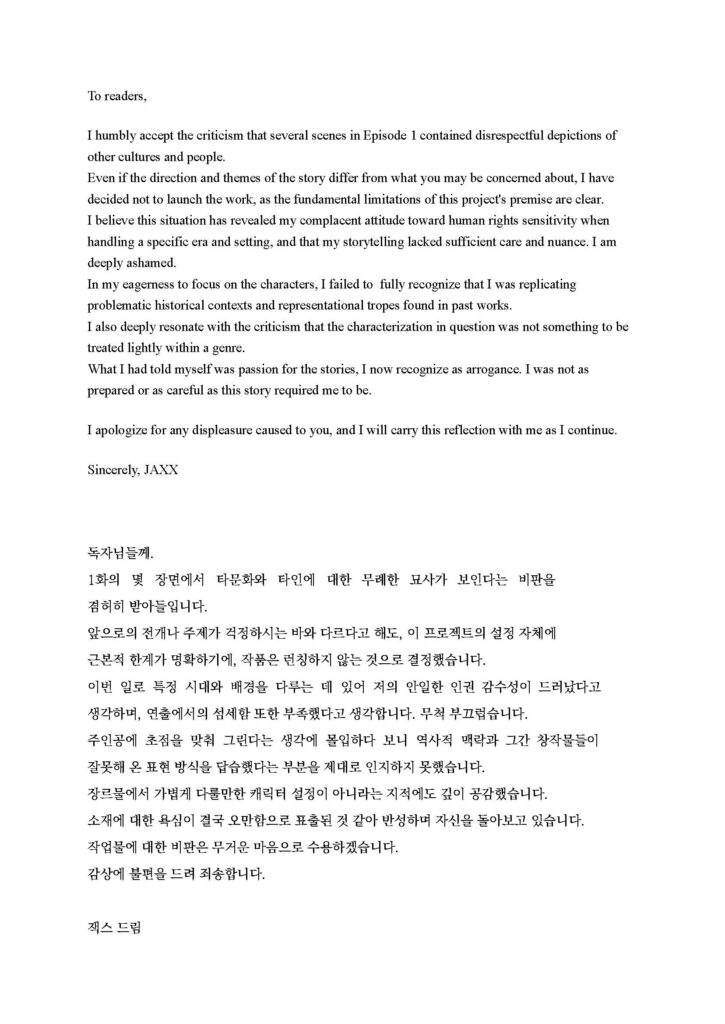
To readers,
I humbly accept the criticism that several scenes in Episode 1 contained disrespectful depictions of other cultures and people.
Even if the direction and themes of the story differ from what you may be concerned about, I have decided not to launch the work, as the fundamental limitations of this project’s premise are clear.
I believe this situation has revealed my complacent attitude toward human rights sensitivity when handling a specific era and setting, and that my storytelling lacked sufficient care and nuance. I am deeply ashamed.
In my eagerness to focus on the characters, I failed to fully recognize that I was replicating problematic historical contexts and representational tropes found in past works.
I also deeply resonate with the criticism that the characterization in question was not something to be treated lightly within a genre like BL.
What I had told myself was passion for the storiesl, I now recognize as arrogance. I was not as prepared or as careful as this story required me to be.I apologize for any displeasure caused to you, and I will carry this reflection with me as I continue.
Sincierly, JAXX
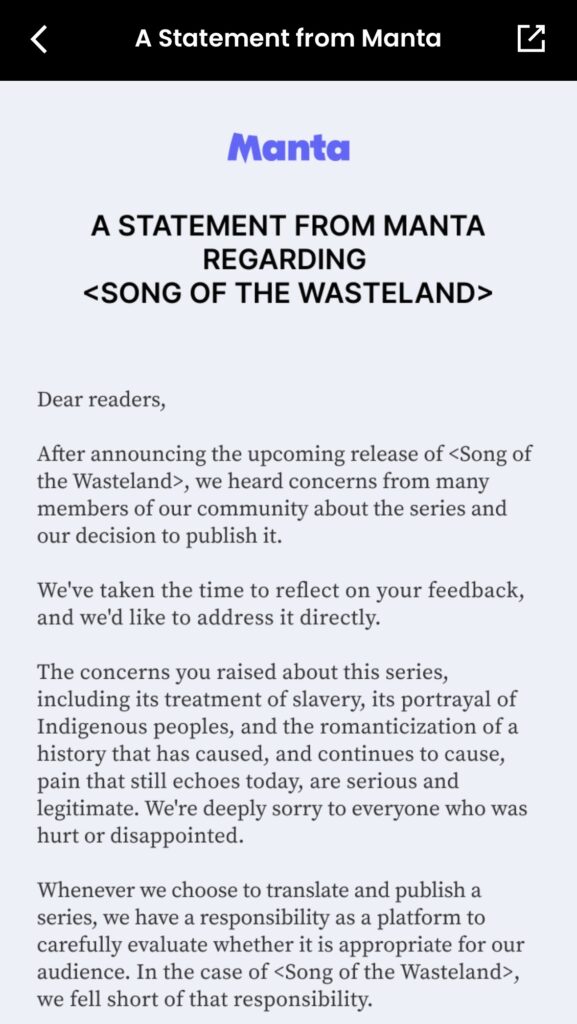
Fans also criticized Manta and RIDI for the lack of care in first serializing this work with the critiques pointed at Manta considering it went through a translation and localization team. The platform has since taken down all promotional material and the first chapter, although the page remains up as of this article’s writing. Manta has issued an apology for its lack of due diligence.
“The concerns [the readers] raised about [Song of the Wasteland], including its treatment of slavery, its portrayal of Indigenous peoples, and the romanticization of a history that has caused, and continued to cause, pain that still echoes today, are serious and legitimate.” It acknowledged, as well, that it had a responsibility to evaluate whether it was appropriate for their audience. This apology appears as soon as you open the Manta app and can be read below:
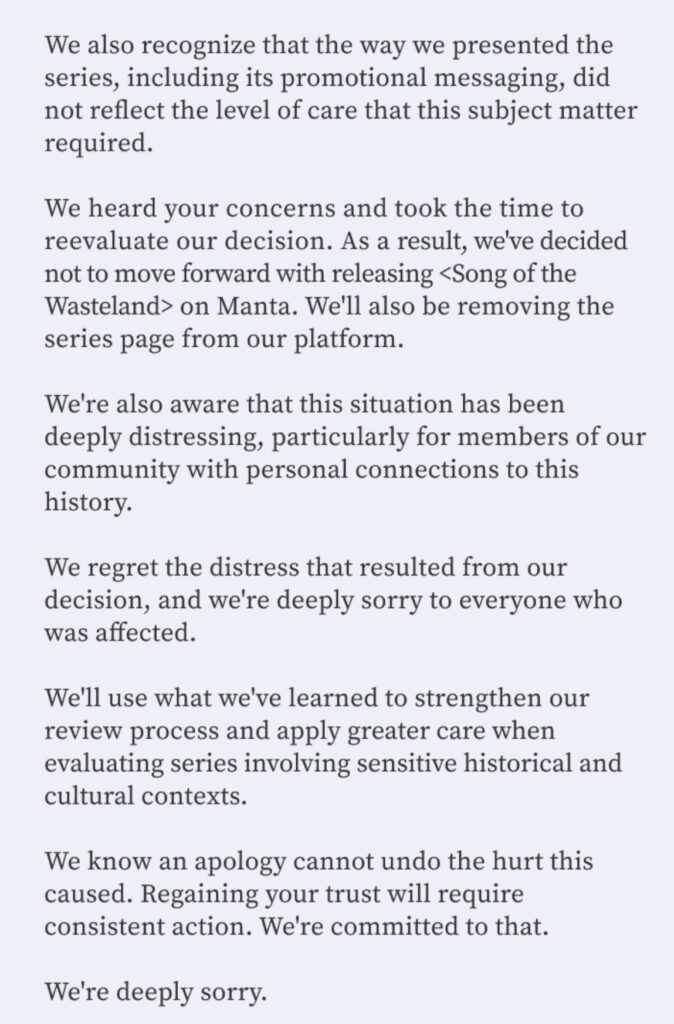
This isn’t the first time that harmful racial stereotypes have been depicted in a manhwa but this appear to be the first time a major BL creator has voluntarily taken down a manhwa and apologized for the harm they have created.
Source: X, formerly known as Twitter
Discover more from Redbeanime
Subscribe to get the latest posts sent to your email.