Written by: Ollie Kaplan
This review is for I Love Amy, Volume 1, by UNNI. Ize Press, a Yen Press imprint, provided a digital review copy in exchange for an honest review.
Ize Press’s debut Girls’ Love manhwa title, I Love Amy by UNNI, will delight readers with its girly pop aesthetic, adorably rendered character designs, and well-paced romantic plotline (the burn is slow, but not too slllooowww) that subverts traditional genre tropes (specifically, those of toxic yuri). While it masquerades as a cute, wholesome high school romance due to its girly pop aesthetic, I Love Amy quickly starts to explore deeper themes, like trauma and its impact on mental wellbeing and relationship dynamics, as well as post-traumatic and emotional growth after adverse experiences.
I Love Amy has a long publication history. It was first released digitally on PeanuToon from 2022 to 2023, but it then moved to the Bomtoon platform in 2025 when PeanuToon shut down. Several print volumes were successfully crowdfunded and published by A. TEMPO MEDIA before the manhwa first found its way to English-language readers on the digital webcomics reader, TappyToon. To finally make it into the hands of English-language print edition readers like myself, Yen Press announced at Sakura-Con 2025 that the series had been licensed by Ize Press, making it the imprint’s first GL release.
“There’s a town in Maine…”
The story is set in Maine because that’s where “many of Stephen King’s novels” are set, UNNI told Ize Press, and because “same-sex marriage is legal in the US,” which gave the creator the freedom to tell a different kind of GL story, one in which the main characters can experience a happy ending “despite their traumatic family lives.”
And the decision to set it in Maine worked as intended (plus, I love the King reference): I Love Amy stands out amongst other GL titles in its subversion of genre tropes—by taking a yandere character (typically, a character with a violent, possessive romantic obsession whose story commonly ends in tragedy) and actually having them go through genuine character growth to get a happy ending.
“It seems that bad things, hurtful things, do right well in the soil of this town…”
I Love Amy follows Bibi, the yandere, who is an aggressive force of nature with a reputation for stirring up trouble—and the reader is introduced to Bibi when her obsessive traits are all working in service of one goal: getting closer to Peter, one of her high school’s most popular boys, whom she’s violently obsessed with. One day, after Bibi notices Peter engrossed in a conversation with their timid, anxious classmate Amy, her jealousy sends her straight into action, and she invites Amy over to her luxurious mansion with the intention of kidnapping her so that she cannot get too close to Peter. Instead, they quickly hit it off, and Bibi decides to befriend Amy so that Amy can help her confess her feelings to Peter. As they continue to hang out together, Bibi’s feelings toward Amy shift—first into something possessive and chaotic, then into something deeper and sincere—so what started as a boy chasing scheme turns into a story about two girls navigating the messy, overlapping lines between friendship and love.
However, UNNI subverts the trope by framing the yandere’s intensity as a traumatic response to an unsatisfied yearning for unconditional love. Bibi’s obsessive traits don’t lead to a horrific downfall; instead, they gradually redirect from a cishet love interest to Amy, who actually accepts her. Whereas many modern dark yuri stories feature toxic relationships where one character destroys the other, I Love Amy subverts this tragedy of toxicity by taking a deeply unhealthy dynamic and turning it into a mutual (and maybe eventually healthy) way to cope with the challenges of life as a young teen. Amy, who has trauma from being raised by an abusive mother, lives with paralyzing anxiety and zero self-esteem. Meanwhile, Bibi, who grew up starved of genuine affection, is entirely unbothered by social boundaries or rules. UNNI structures their dynamic so that Bibi and Amy do not “fix” each other’s deep psychological issues; instead, they find a perfect, jagged puzzle-piece fit in their mutual brokenness. Amy unconditionally loves Bibi, admiring Bibi for her good traits (strong, unique) and bad ones (chaotic, possessive), and giving Bibi the love and validation she has never received from her guardians. While other characters often respond negatively to Bibi’s behavior, Amy sees it as a strength, which serves as a refuge from her trauma, giving her the strength to start facing her fears.
“People who build their houses in your heart…”
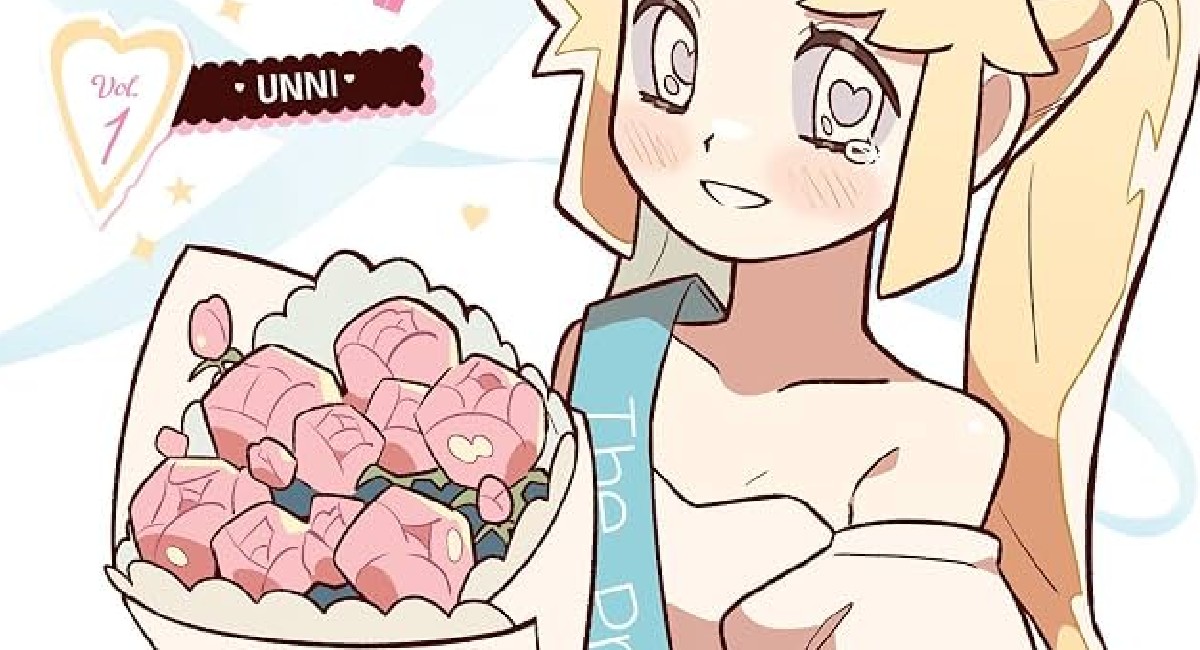
Visually, I Love Amy has a deceptively cute, girly pop aesthetic with a complementary bubblegum color palette, which masks its psychologically intense narrative. The dissonance between UNNI’s sugary art style and the manhwa’s dark narrative is immediately noticeable with the creator’s hyper-cute yandere protagonist Bibi, who, as it was previously mentioned, is an unhinged, ultra-wealthy sociopath who stabs classmates with forks, stalks her crush, and keeps a taxidermied pet rabbit in her bedroom. Thanks to these artistic choices, the “pure schoolgirl” trope is entirely dismantled by placing a textbook yandere in a setting that looks more like a Sanrio cartoon—and not one of the Sanrio cartoons co-starring Kuromi.
Additionally, the art style highlights the fundamental differences between I Love Amy’s two leads, treating them as complete visual opposites. Bibi sports pristine blonde pigtails that occasionally twist into stylized bunny ears, flawless skin, ultra-vibrant, prim and fashionable clothing, and iconic heart-shaped pupils that are oddly dull, subtly hinting at her emotional challenges and traumatic past. In contrast, Amy is disorganized, unpolished, and vulnerable, with unruly, messy short black hair that sticks out in tufts, an uneven fringe that falls over her eyes, and is constantly covered in bandages and band-aids (on that last point, the many band-aids that Amy wears are obviously meant to represent both the character’s lack of self-care and tendency to “seek out” things that will hurt her, figuratively and literally.
Because of financial constraints, I haven’t read much of the series in its vertical scroll format so I can’t speak to how the print edition compares to the series original format. So all I can speak to (at least confidently) is my enjoyment of this print volume, and overall, I found the first volume of I Love Amy to be a surprisingly complex and nuanced exploration of trauma and its implications, which is clearly setting up a story that is more than just “this girl’s crazy,” and that’s easily my favorite aspect from the perspective of someone who struggles with the impact of their own trauma on their ability to maintain open, healthy relationships. While, at the end of Volume 1, it seems like things may get worse for Bibi and Amy before they get better, I know enough about this story from the popular zeitgeist to know that ultimately this is a story of post-traumatic growth—and one that reminds us that even the most damaged individuals can learn from their mistakes, form healthy bonds with others, and find true happiness that doesn’t come at the expense of others’ feelings and well-being.
I Love Amy, Vol. 1 is available now.
Discover more from Redbeanime
Subscribe to get the latest posts sent to your email.